
HPC clusters · Building clusters since 2001
Turn-key HPC, ready to work.
Fully integrated HPC clusters designed to accelerate discovery, innovation and business outcomes. Whether it’s your first cluster or an expansion, we handle every step from design to deployment.
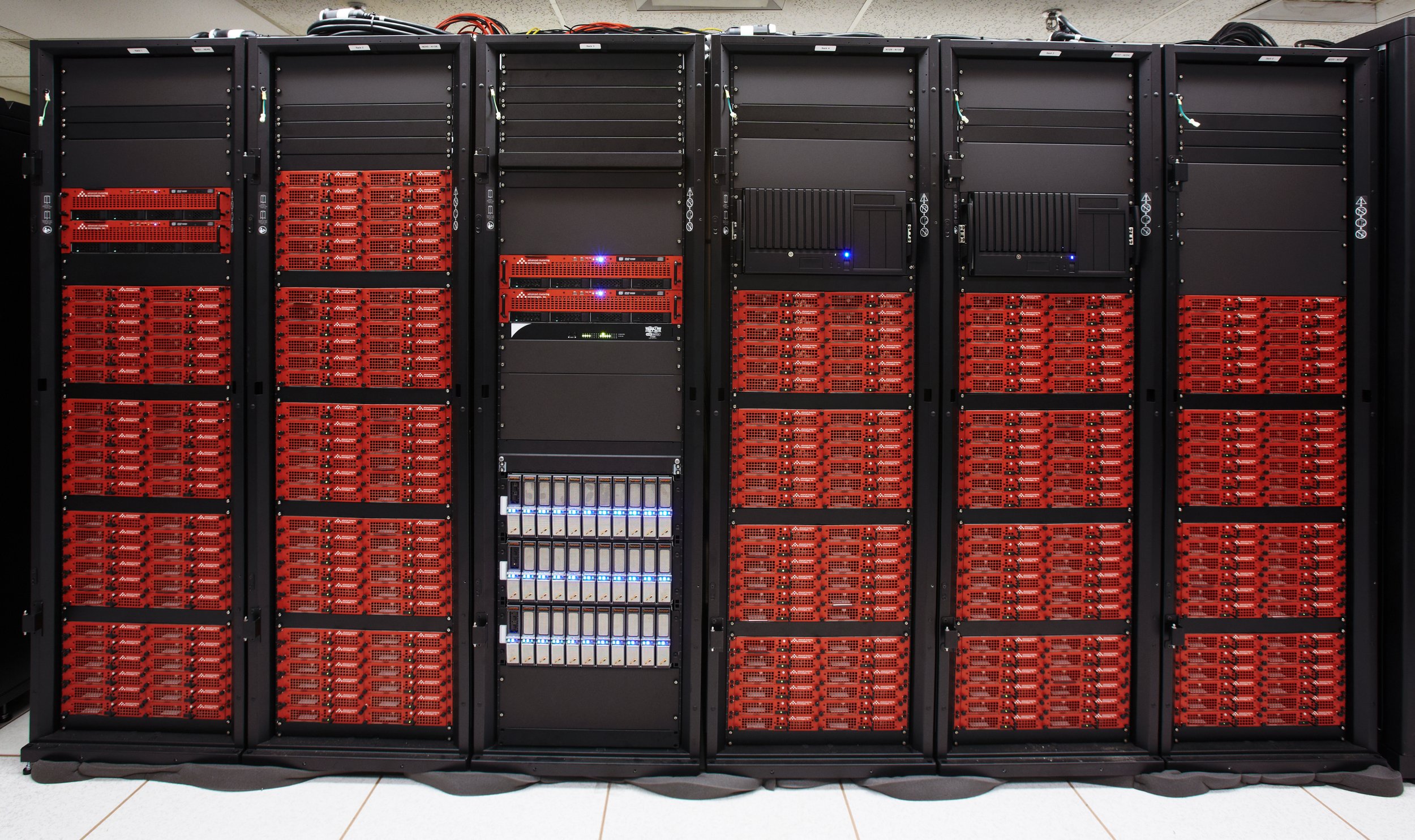
Why our clusters
Seven reasons research groups and enterprises keep coming back to ACT.
Turn-key systems
A complete HPC environment, designed, integrated, tested, installed and supported as a single solution.
Deep HPC specialization
We’ve specialized in HPC since 2001, building clusters for research and engineering.
Flexible deployment
Scale your resources without being locked into a single deployment model.
Backed by ClusterVisor
Unlike vendors that rely on third-party management tools, we control the software stack.
Hardware integration
Less time between purchase and productive work, so you can get on with yours.
User training
Our engineers take the time to train your team, whatever their level of experience.
Lifetime support
Support for the life of the system, not just the warranty period: deployment, upgrades and more.
A complete solution, start to finish
Step 1
Custom system design
Compute, storage, networking and software, every component purpose-built for you.
Step 2
Integration and testing
Assembled, configured and tested before it ships, for top performance from day one.
Step 3
On-site deployment
Our experts install it and make sure everything is operational before we leave.
Step 4
Knowledge transfer and training
Training and documentation so your team can manage the cluster with confidence.
Inside the cluster
Every layer, engineered together.
A cluster is more than a rack of servers. We design compute, acceleration, networking, storage, software and power as one system, sized to your workloads and your facility.
Layer by layer
What goes into each layer.
Compute nodes
Intel and AMD CPU nodes balanced for core count, clock speed and memory bandwidth, with memory per core sized to your largest jobs.
GPU acceleration
GPU nodes for simulation and other accelerated codes, with the GPU-to-GPU and node-to-node bandwidth that multi-GPU jobs need.
Building for AI? See AI solutions →High-speed interconnect
Low-latency InfiniBand, Omni-Path or high-speed Ethernet fabrics for tightly coupled MPI jobs, with a separate network for management.
Parallel storage
BeeGFS parallel file systems and fast scratch tiers that scale bandwidth as the cluster grows, alongside home and archive storage.
See storage solutions →Software stack
Every cluster is built around ClusterVisor, our cluster management software, for provisioning, monitoring and managing every node. It’s paired with Linux, the Slurm scheduler, compilers, MPI and scientific libraries, all installed and tested so your users can run jobs on day one.
Explore ClusterVisor →Power, cooling and facility
Rack layout, power distribution and cooling planned around your data center, so the cluster fits the space and power you have.
Inside the network
Why the network matters.
Every step waits on its neighbors
Simulations split across nodes trade edge data after every step. No node can move on until those small messages arrive.
Where speed really comes from
Tightly coupled jobs exchange thousands of small messages every step, so low latency often matters more than raw bandwidth.
Oversubscription, sized to your workload
Most jobs rarely fill the uplinks between racks, so a modest oversubscription saves money with little impact. We size it to the traffic you actually run.
Clusters we’ve built
In our customers’ words.
“
Some workloads have run up to twice as fast on this cluster as on the previous cluster while using the same number of cores.
Dana Brunson · Oklahoma State University
Read the case study →“
Through its performance, our cluster has aided our research by shortening project completion time and speeding up research findings.
Research Institute · Nationwide Children’s Hospital
Read the case study →“
There were some concerns about choosing a smaller vendor, but Advanced Clustering’s reputation for providing quality support quickly put those to rest.
Malcolm Tobias · Washington University in St. Louis
Read the case study →How we work
Our approach to building an HPC cluster
Let’s build an HPC solution that works for you, right out of the box.
Grants and procurement
Funded by a grant? We help from start to finish.
From the first conversation about your research to the day your cluster goes into production, we work alongside your team through the whole grant and purchasing process.
1
Plan. We help you size a system around your science and your budget.
2
Propose. Technical descriptions, configurations and quotes for your proposal.
3
Procure. Specifications and support for your RFP and purchasing process.
4
Deliver. We build, install and support the system your grant funded.
Free guide
NSF MRI grant white paper
Our guide to planning a grant-funded HPC system, from scoping to proposal.
Get the white paper →Free guide
HPC RFP guide
What to include in an RFP so vendors can quote accurately and you can compare bids fairly.
Get the RFP guide →Already have a cluster?
Expand it, refresh it, or bring it under management.
Whoever built your cluster, we can add compute, GPU or storage nodes, refresh aging hardware, and deploy ClusterVisor so everything is managed in one place.
Run it with confidence
Managed from day one.

Included with every cluster
Our cluster management software comes installed and configured on every cluster we build: monitoring, alerts, provisioning, job visibility and rack diagrams across every node, from the day it’s installed. It supports SELinux in enforcing mode, and its enhanced security option adds full disk encryption and FIPS mode.
Explore ClusterVisor →Optional
Managed services
Want us to run it too? Our engineers monitor, patch, tune and support your cluster, with coverage and pricing built around how you use it.
See managed services →FAQ
Questions cluster buyers ask.
Have a question that isn’t here? We’re happy to talk it through.
Ask us →Do you install on-site?
Your cluster ships fully assembled in the rack, which makes setup a breeze. If you’d like, our engineers can also install it on-site and train your team to run it.
Can you work with our existing storage?
Yes. We can provide storage or integrate with what you already have, of any type, from simple NFS to parallel file systems.
Can we expand the cluster later?
Yes. Our clusters are built to be modular, so you can add compute, GPU or storage nodes as your needs grow. We can also help you expand a cluster you already have.
What warranty options are available?
Full warranty options, including 24/7 support and on-site service if you need them.
We have strict security requirements. Can we keep failed drives?
Yes. Our warranty options let you keep failed storage drives and other non-volatile components, so sensitive data never leaves your site. ClusterVisor’s enhanced security option also adds full disk encryption and FIPS mode.
Let’s talk about your HPC cluster.

Engineering the future of HPC and AI
info@advancedclustering.com(866) 802-82223148 Roanoke Road, Kansas City, MO 64111