
Caltech
Caltech implements ClusterVisor 1.0 to more effectively manage its HPC cluster and workloads
Caltech upgraded to ClusterVisor 1.0 while its new cluster was being installed in January 2023.

Objective
To leverage a cluster management solution to more effectively monitor cluster health and manage workload performance across nodes.
Challenges
Caltech has a small staff of systems administrators and an ever-increasing HPC user base with demanding workloads waiting to run on the cluster.
Approach
Using ClusterVisor 1.0 cluster management system from Advanced Clustering Technologies, Caltech hopes to make cluster management a more streamlined and easy-to-manage task.
Innovation matters
The latest edition of ClusterVisor has given the team at Caltech powerful tools that are increasing productivity across workloads while simplifying the task of managing and monitoring the cluster and its workloads.
Caltech implements ClusterVisor 1.0 to more effectively manage HPC cluster
Caltech was already using the original version of ClusterVisor when they were offered an upgrade to ClusterVisor 1.0 while their new cluster was being installed in January 2023.
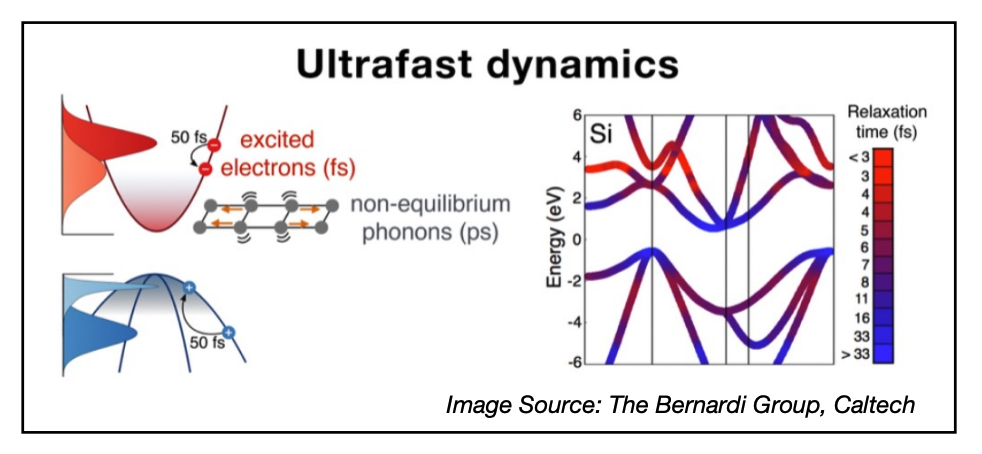
“The original version of ClusterVisor was already user-friendly. With the new version, what’s great is that you have the dashboards,” explains Ivan Maliyov, a postdoctoral scholar in Professor Marco Bernardi’s group working on theory and computational methods to study the behavior of electrons in materials.
Maliyov says the group is able to configure the dashboards in many ways. “We can create multiple tabs, and for each tab you can create multiple charts or tables or other data to report on the cluster. When I connect to ClusterVisor, at a glance I can see the status of the cluster, that everything works or maybe something doesn’t work. It’s great for me to spend only three seconds and see how we’re doing today.”
Another important feature of ClusterVisor 1.0 is the ability to easily create a rack diagram of the entire cluster and incorporate statistics to give a visual report on the status of the cluster.
“We can see the temperature of the nodes just in case the cooling of one node is going wrong,” Maliyov said. “We can see that.”
The team at Caltech is using ClusterVisor to test a special software development project. “Our software that we are developing – RAM is usually the bottleneck. Memory is crucial with us. Nobody has this great tool. We have been sharing our excitement.” As Maliyov explains it, the ability to overcome this RAM bottleneck may be the most important contribution ClusterVisor has made to the work being done by Professor Bernardi’s team at Caltech.
“The one feature I really wanted to mention and say how it’s really important to us is for a particular job that we are running on the cluster, we are able to track the RAM memory as a function of time,” Maliyov said. “This is wonderful, not only to see how our software runs on the cluster, but also to test our software.”
“This is great. In order to have this level of information, you would usually need to compile our software with the compilers,” Maliyov said. “ClusterVisor shows this right away. We can also change the timestamp with which we have the updates on the RAM memory every 10 seconds or every minute and that’s amazing for us.”
“For the software that we’re developing in the group, the HPC bottleneck is the RAM memory usage. So, we have to use more nodes not only to run our software faster but also just to fulfill our RAM requirements so, memory is crucial for us,” he said. “That’s why the 512GB per node and controlling this memory is very important to us. We are talking to our peers in the U.S. and Europe and nobody among them has these tools. We share our excitement with other people and say we have this feature. So, that’s great.”
Want results like these?
Tell us about your cluster, your workloads and your budget, and we’ll bring in the right engineers.
Talk to usMore customer stories
How universities, national labs and companies use Advanced Clustering systems, software and services.
All case studies
Engineering the future of HPC and AI
info@advancedclustering.com(866) 802-82223148 Roanoke Road, Kansas City, MO 64111